

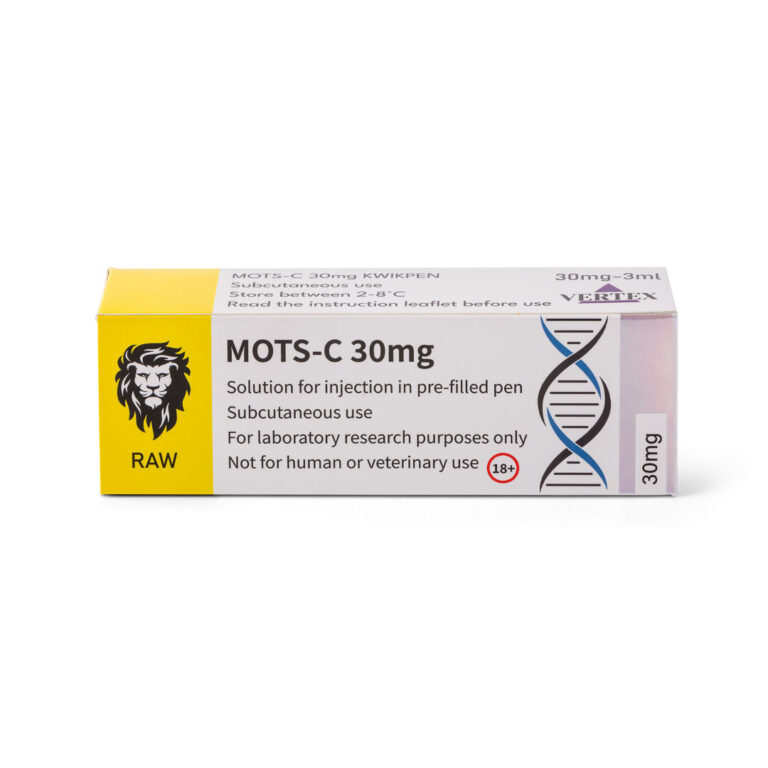
MOTS C Peptide 30mg (R&D Only)

$101.00
MOTS C Peptide 30mg (R&D Only)
MOTS-C Peptide 30mg is a high-purity, research grade mitochondrial derived peptide encoded by mitochondrial DNA. Studied for its role in glucose metabolism, insulin sensitivity, fat oxidation, and anti-aging pathways, MOTS-C Peptide supports cellular energy homeostasis and metabolic regulation in preclinical research settings.
MOTS-c Peptide 30mg: The Comprehensive Guide to Mitochondrial Research
MOTS C Peptide 30mg has become an increasingly important topic in metabolic and mitochondrial research because scientists continue to investigate how this naturally occurring peptide influences cellular energy regulation. Unlike many synthetic peptides, MOTS-c is classified as a mitochondrial-derived peptide (MDP), meaning it originates from mitochondrial DNA rather than nuclear DNA. Researchers are exploring its potential role in metabolic health, insulin sensitivity, exercise physiology, and healthy aging. This educational guide examines the current scientific understanding of MOTS-c Peptide 30mg, its biological mechanisms, laboratory quality considerations, and emerging areas of research. Research peptide products are intended solely for authorized laboratory research and are not approved medications for general consumer use.
The Science of MOTS-c
MOTS C Peptide 30mg is a naturally occurring peptide encoded within mitochondrial DNA. It was first identified as one of several mitochondrial-derived peptides involved in cellular communication and metabolic regulation.
Researchers have become interested in MOTS-c because mitochondria play a central role in producing cellular energy. Rather than serving only as energy-producing structures, mitochondria also generate signaling molecules that help coordinate cellular responses to metabolic stress.
Mitochondrial Derived Peptide MOTS-c
As a mitochondrial derived peptide MOTS-c, it differs from many traditional signaling peptides because of its origin and biological activity.
Studies suggest MOTS-c may participate in regulating:
- Cellular metabolism
- Energy balance
- Glucose utilization
- Stress responses
- Skeletal muscle function
These findings continue to be investigated in laboratory and clinical research.
AMPK Activation and Glucose Regulation
One major area of research focuses on how MOTS-c interacts with AMP-activated protein kinase (AMPK), an enzyme involved in maintaining cellular energy balance.
AMPK functions as an energy sensor within cells. When activated, it helps coordinate metabolic processes that support efficient energy utilization.
Researchers are exploring whether MOTS-c influences:
- Glucose metabolism
- Insulin signaling
- Cellular energy regulation
- Fat metabolism
- Skeletal muscle adaptation
Although early findings are promising, additional research is needed to clarify these biological pathways.
Mitochondrial Health and Exercise Research
Several experimental studies have examined MOTS C Peptide 30mg endurance and energy research, investigating whether the peptide may influence physiological adaptations associated with exercise.
Current research has explored potential effects on:
- Exercise capacity
- Muscle metabolism
- Cellular energy production
- Mitochondrial function
- Metabolic flexibility
These studies are ongoing, and further clinical investigation is necessary before drawing conclusions regarding therapeutic applications.
MOTS-c Peptide 30mg Product Overview
MOTS-c Peptide 30mg is commonly supplied as a lyophilized (freeze-dried) powder for laboratory research.
Lyophilization is widely used because it supports peptide stability during storage and transportation when handled according to manufacturer recommendations.
Researchers evaluating peptide materials often consider:
- Product identity
- Batch consistency
- Analytical testing
- Stability information
- Manufacturing quality
- Documentation
These factors contribute to reliable laboratory research.
Research Grade MOTS C Peptide 30mg Lyophilized Powder
Research laboratories frequently use lyophilized peptide formulations because freeze-drying helps preserve structural integrity before laboratory preparation.
Product documentation may include:
- Batch identification
- Storage recommendations
- Product specifications
- Manufacturing records
- Analytical testing summaries
Researchers should follow institutional protocols and manufacturer guidance when handling investigational materials.
MOTS C Peptide 30mg Peptide COA HPLC Purity
Quality assurance is a key consideration in peptide research.
Researchers often review:
- Certificate of Analysis (CoA)
- High-performance liquid chromatography (HPLC)
- Mass spectrometry (MS)
- Identity testing
- Batch information
- Purity assessments
A batch-specific CoA helps verify that research materials meet stated laboratory specifications.
Laboratory Storage Considerations
Maintaining appropriate storage conditions supports peptide stability throughout laboratory research.
General laboratory practices include:
- Following manufacturer storage recommendations
- Protecting materials from heat, moisture, and direct sunlight
- Maintaining recommended storage temperatures
- Recording storage conditions as part of laboratory quality systems
Specific requirements may vary depending on the manufacturer and research protocol.
Current Areas of Research
Scientists continue studying MOTS C Peptide 30mg peptide metabolic benefits across several research fields.
Current investigations include:
- Metabolic regulation
- Insulin sensitivity
- Skeletal muscle biology
- Healthy aging
- Exercise physiology
- Mitochondrial communication
Experimental findings continue to expand our understanding of mitochondrial-derived peptides, although additional human research remains necessary.
MOTS-c vs. SS-31 Mitochondrial Peptides
Researchers often compare MOTS-c vs SS-31 mitochondrial peptides because both relate to mitochondrial biology, yet they differ in their mechanisms.
| Feature | MOTS-c | SS-31 |
|---|---|---|
| Origin | Mitochondrial-derived peptide | Synthetic peptide |
| Primary Focus | Cellular signaling and metabolic regulation | Mitochondrial membrane interactions |
| Research Areas | Metabolism, exercise physiology, insulin sensitivity | Mitochondrial protection and oxidative stress |
Although both are being studied for mitochondrial function, they have distinct biological targets and should not be considered interchangeable.
Safety Considerations
Research involving MOTS C Peptide 30mg continues to evaluate both efficacy and safety.
As an investigational peptide, its long-term effects are still being studied. Researchers should consult peer-reviewed publications, institutional guidelines, and regulatory information when working with investigational compounds.
Frequently Asked Questions
What is MOTS-c Peptide 30mg?
It is a research-grade formulation containing the mitochondrial-derived peptide MOTS-c for authorized laboratory investigation.
What makes MOTS C Peptide 30mg unique?
Unlike many peptides, MOTS-c is encoded by mitochondrial DNA and is being studied for its role in cellular metabolism and energy regulation.
What is a Certificate of Analysis?
A Certificate of Analysis is a laboratory document that typically includes product identity, analytical methods, purity results, and batch information.
What does HPLC testing verify?
High-performance liquid chromatography helps assess peptide purity and supports laboratory quality assurance.
Is MOTS-c approved for medical use?
Research peptide products containing MOTS C Peptide 30mgare intended for laboratory research. Their regulatory status depends on the specific formulation and jurisdiction.
Conclusion
MOTS C Peptide 30mg continues to be an important focus of mitochondrial and metabolic research because of its unique origin and potential role in cellular energy regulation. Ongoing studies are expanding scientific understanding of how mitochondrial-derived peptides influence metabolism, exercise physiology, and healthy aging. Researchers evaluating MOTS-c should prioritize transparent analytical documentation, batch-specific Certificates of Analysis, and adherence to established laboratory quality standards. For the most reliable and up-to-date information, consult peer-reviewed scientific literature, regulatory guidance, and manufacturer documentation.
Be the first to review “MOTS C Peptide 30mg (R&D Only)”
Related products
Alluvi Peptides

Raw Peptides
Raw Peptides

Alluvi Peptides

Alluvi Peptides

Synedica
Synedica
Raw Peptides
Reviews
There are no reviews yet.