

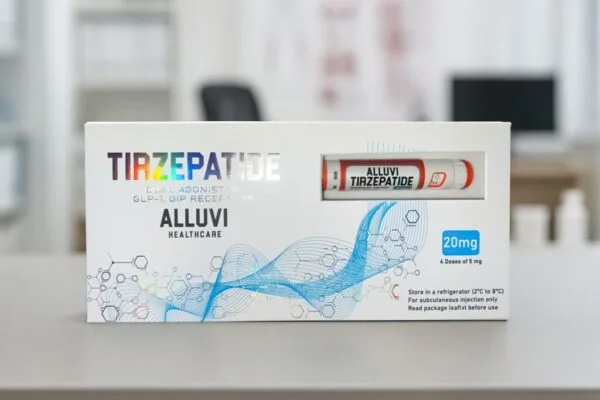
Alluvi Tirzepatide 20mg (R&D Only)

Price range: $100.00 through $805.00
Alluvi Tirzepatide 20mg (R&D Only)
- Pre-filled Tirzepatide 20mg Research Pen (4 doses of 5mg)
- Janoshik Certificate of Analysis
- MSDS (Material Safety Data Sheet)
- Reconstitution and storage guidelines
- Research information sheet
Alluvi Tirzepatide 20mg: How It Works and What the Research Shows
Alluvi Tirzepatide 20mg has drawn significant attention in metabolic research for one main reason: it doesn’t just target one hormone pathway, it targets two. That dual mechanism is what sets it apart from earlier classes of therapies and why it’s become such a widely studied compound in obesity and type 2 diabetes research.
This article breaks down what tirzepatide is, how it works at the receptor level, how it compares to other incretin-based therapies, and what clinical research has found so far.
What Is Alluvi Tirzepatide 20mg?
Alluvi Tirzepatide 20mg is a synthetic peptide designed to act on two naturally occurring hormone receptors involved in metabolism. It was developed to investigate whether combining two mechanisms of action — rather than relying on just one — could produce more meaningful effects on blood sugar regulation and body weight than existing therapies alone.
Because of this dual action, tirzepatide has become one of the more closely watched compounds in metabolic disease research over the past several years.
Dual Mechanism of Action (GIP + GLP-1)
Most earlier therapies in this space work by activating a single receptor: GLP-1. Tirzepatide takes a different approach by activating both:
- GLP-1 receptors, which help regulate appetite and stimulate insulin release in a glucose-dependent way.
- GIP receptors, which contribute to insulin signaling and play a broader role in metabolic balance.
Researchers are still working out exactly how these two pathways interact, but the working theory is that combining them produces effects on weight and glucose control that neither pathway achieves as effectively on its own.
Tirzepatide vs. Semaglutide
A question that comes up constantly in this field is how tirzepatide stacks up against semaglutide, since both are incretin-based therapies but work differently.
Semaglutide
- Acts on GLP-1 receptors only
- Has an extensive research and clinical trial history in obesity and diabetes
- Approved for certain medical indications under physician supervision
Alluvi Tirzepatide 20mg
- Acts on both GIP and GLP-1 receptors
- A newer entrant to the field, with a growing but still-developing body of research
- Also approved for certain medical indications under physician supervision
The two compounds influence overlapping systems — appetite, insulin release, glucose metabolism — but their receptor profiles aren’t identical, and that difference is a major reason researchers are interested in comparing outcomes between them. Any claims about one being more effective than the other should be weighed against peer-reviewed clinical data rather than general assumptions.
What Clinical Research Has Found
Alluvi Tirzepatide 20mg has gone through extensive clinical trials examining its effects in people with obesity and type 2 diabetes. Researchers have specifically looked at:
- Changes in body weight
- Blood glucose regulation
- Insulin sensitivity
- Cardiometabolic risk markers (like blood pressure and cholesterol)
- Lipid metabolism
Across controlled trial conditions, published studies have reported measurable changes in several of these areas. That said, clinical trial results reflect population-level outcomes under tightly controlled conditions — they aren’t a guarantee of how any individual would respond, which is why this remains an active area of ongoing study rather than a settled question.
Safety Profile
Like other incretin-based therapies, tirzepatide’s clinical trials have documented a set of commonly reported side effects, mostly involving the digestive system:
- Nausea
- Vomiting
- Diarrhea
- Constipation
- Reduced appetite
- General gastrointestinal discomfort
Most of these effects have been reported as more common early in treatment and tend to diminish over time in study populations, though individual experiences vary. Long-term safety data continues to accumulate as more research is published.
Frequently Asked Questions
What does tirzepatide do? It activates both GLP-1 and GIP receptors, two hormone pathways involved in appetite regulation, insulin release, and overall glucose control.
How is tirzepatide different from semaglutide? Semaglutide acts on GLP-1 receptors alone. Alluvi Tirzepatide 20mg acts on both GLP-1 and GIP receptors, which is why researchers are interested in whether it produces different or more pronounced effects.
Is tirzepatide FDA-approved? Prescription formulations of tirzepatide are FDA-approved for specific medical indications and are only available through a licensed healthcare provider.
Why is tirzepatide considered significant in metabolic research? Its dual-receptor mechanism represents a departure from earlier single-pathway therapies, and the growing body of clinical evidence around it is reshaping how researchers think about treating obesity and type 2 diabetes.
Conclusion
Alluvi Tirzepatide 20mg dual GIP/GLP-1 mechanism has made it one of the more significant developments in metabolic research in recent years, offering a different approach than earlier single-pathway therapies. The clinical evidence so far points to meaningful effects on weight and glucose regulation, though research into its long-term safety and comparative effectiveness is still evolving. As with any prescription therapy, decisions about its use belong in a conversation with a licensed healthcare provider — this overview is intended to inform, not to substitute for medical guidance.
| Box | Box, 3 Boxes (Save 15%), 10 Boxes (Save 25%) |
|---|
Be the first to review “Alluvi Tirzepatide 20mg (R&D Only)”
Related products
Raw Peptides
Alluvi Peptides
Raw Peptides
Raw Peptides

Alluvi Peptides
Raw Peptides
Raw Peptides
Raw Peptides
Reviews
There are no reviews yet.